Listen to article
Read aloud with your device’s voice
At the Sarit Centre in Nairobi, books are being used to do more than tell stories.
They are being used to introduce visitors to another language, history and culture, while
creating opportunities for publishers from China and Africa to explore how their ideas and
content can cross borders.
More than 600 Chinese cultural products were on display at an exhibition running alongside
the Nairobi International Book Fair between September 24, and 27, 2026. The exhibition
includes more than 300 books, traditional cultural products and interactive activities that
allow visitors to experience aspects of Chinese culture.
The exhibition is the Kenyan stop of the second China Culture Touring Exhibition in Africa.

It is being held under the theme, “Books Bring Us Together, Discovering China Through
Reading.”
Its timing gives it added significance.
China and Africa are marking 2026 as the China-Africa Year of People-to-People
Exchanges, an initiative agreed at the 2024 Forum on China-Africa Cooperation summit in
Beijing.
The programme covers education, culture, publishing, tourism, youth exchanges, science and
technology and other areas. China and African countries have also identified cultural and
people-to-people exchanges as an important part of strengthening ties between their
populations.
The Nairobi exhibition provides a practical example of what that ambition can look like.
Rather than being confined to diplomatic meetings, the interaction is taking place through
books, publishers, cultural products and direct encounters between visitors and Chinese
cultural traditions.
From books to cultural understanding
Xiong Liguo, assistant general manager of Xiamen International Book Company Limited,
said the exhibition was intended to give Kenyans a chance to encounter Chinese literature
and culture directly.

“It provides us with an opportunity for foreigners to appreciate Chinese literature. We also
have a chance to sample other countries’ books to showcase to Chinese readers,” he said.
The comment points to an important feature of cultural exchange.
It is not only about one side presenting its culture to the other. It also creates opportunities for
the exchange of ideas and content in both directions.
The China-themed section at the exhibition is divided into three areas: book publishing,
Chinese cultural and creative products, and an interactive cultural experience.
The book section has more than 300 titles covering traditional Chinese culture, Chinese
language learning, fiction, comics and children's literature.
There are also different editions of Xi Jinping: The Governance of China, alongside works
from leading Chinese publishing houses.
For a Kenyan reader, the range provides several possible entry points into China.
A student learning Chinese can find language material. A reader interested in literature can
explore fiction. A child can encounter Chinese stories through comics and children's books.
Someone interested in China's society and development can access other categories of
publications.
This makes the exhibition different from a conventional display of diplomatic materials.
It places cultural knowledge in the hands of ordinary readers.
The importance of publishing in China-Africa relations
Publishing may appear less visible than infrastructure, trade or investment in discussions
about China-Africa relations.
But it can have a long-term influence because books shape how people understand societies
they may never have visited.
The Chinese and Kenyan governments have increasingly identified people-to-people and
cultural exchanges as part of the broader bilateral relationship.
In a joint statement issued during President William Ruto's state visit to China in April 2025,
Kenya and China agreed to strengthen people-to-people exchanges and mutual learning
between their civilizations.
The two sides also agreed to strengthen education exchanges, promote Chinese-language
education in Kenya and support cooperation between Chinese and Kenyan universities in
academic and scientific research.
Publishing fits into that agenda because it creates a channel through which knowledge can
move between societies.
The 2025-2027 FOCAC Beijing Action Plan specifically identifies cultural exchange and
cultural trade as areas for closer China-Africa cooperation. It calls for the advancement of the
China-Africa Cultural Silk Road programme and encourages interaction in areas including
books, libraries, cultural heritage, arts and cultural industries.
The Nairobi exhibition is therefore taking place within an established policy framework.
But the significance of the event will ultimately depend on what happens beyond the
exhibition hall.
If books are translated, rights are exchanged, local publishers acquire Chinese titles and
Kenyan works reach Chinese readers, the relationship moves from cultural presentation to a
two-way publishing relationship.
That is where the business discussions taking place alongside the exhibition become
important.
A marketplace for ideas and publishing rights
The Nairobi event has brought Chinese and African publishers together to discuss copyright
trade, joint content development and processing services.
Organisers said African publishers had expressed interest in acquiring rights to Chinese
literature, fiction, children's books and picture books for their local markets.
This introduces an economic dimension to the cultural exchange.
A book that crosses a border through a publishing agreement can continue reaching readers
long after an exhibition has closed.
It can be translated, reprinted and distributed through local networks.
For Chinese publishers, African markets offer an opportunity to reach new readers.
For African publishers, access to Chinese content creates another source of material for local
audiences.
There is also potential for African publishing content to move in the opposite direction.
Xiong's observation that Chinese representatives also have an opportunity to sample books
from other countries highlights the possibility of a two-way exchange.
That matters because meaningful people-to-people relations cannot be built only around one
society explaining itself to another.
They also require listening and learning.
Cultural products make the exchange more accessible
Not every visitor who enters the exhibition will be looking for an academic book.
The organisers have therefore included cultural and creative products designed to make
Chinese culture more accessible.
The section combines traditional heritage with modern design.
Among the products are stationery inspired by a Southern Song Dynasty bookshop,
calligraphy-themed canvas bags, panda plush toys and products featuring elements of
southern Fujian culture.
Some products, including panda keychains, attracted strong interest from visitors.
Organisers said some Chinese-inspired products sold out within hours of the exhibition
opening.
That interest is significant because cultural engagement often begins with something simple.
A visitor may first be attracted by a panda toy or a traditional design. Another may try on
traditional clothing. Someone else may pick up a children's book.
That first encounter can become an opening to a deeper interest in Chinese history, language
or society.
The exhibition's organisers appear to have deliberately designed the event around this
progression—from seeing and touching cultural objects to reading and experiencing culture.
From watching culture to experiencing it
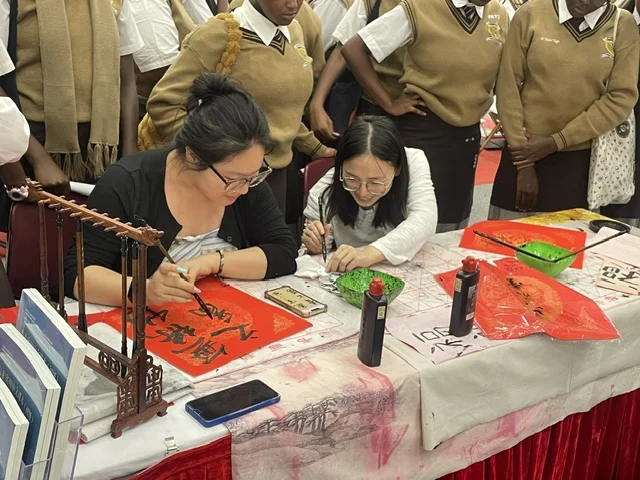
The interactive section allows visitors to try traditional Chinese clothing and participate in
cultural activities.
Visitors can wear Hanfu, traditional Chinese attire, try flower hairpins and make their own
lacquer fans.
The activities have attracted long queues.
This is a different form of cultural exchange from simply displaying artefacts behind glass.
Visitors become participants. They can physically engage with aspects of Chinese cultural
traditions rather than only observing them.
That approach is consistent with the broader emphasis placed on people-to-people interaction
during the 2026 China-Africa Year.
China's Foreign Ministry says the programme is intended to promote mutual learning
between Chinese and African civilizations through activities involving young people, culture,
tourism, publishing, sports, education, science and technology and other sectors.
The programme includes a China-Africa Cultural Silk Road Exchange Month, cultural and
tourism exchanges, dialogue between Chinese and African civilizations, Chinese film
activities and events at Confucius Institutes in Africa.
The Nairobi exhibition fits naturally into that wider calendar.
Why Nairobi matters
Kenya has a significant role in China's engagement with Africa, including in education,
culture and media.
The two countries have maintained diplomatic relations for more than six decades. Their
relationship has expanded into trade, infrastructure, education, technology, culture and
people-to-people exchanges.
The April 2025 Kenya-China joint statement specifically called for greater cooperation in
culture, tourism, youth, sports, media and education. It also identified Chinese-language
education and cooperation between universities as areas for further development.
Nairobi is also home to Confucius Institutes and Chinese-language programmes that provide
Kenyan students with opportunities to learn the language and engage with Chinese culture.
The presence of the book exhibition alongside the Nairobi International Book Fair adds
another layer to that ecosystem.
The exhibition is not operating in isolation.
It is being placed in a gathering where Kenyan readers, publishers, authors, booksellers,
educators and other industry players are already discussing books and publishing.
That creates opportunities for direct professional engagement.
Chinese publishers can meet Kenyan counterparts. Kenyan publishers can explore Chinese
content. Readers can discover Chinese literature. Educators can identify learning resources.
And cultural organisations can examine opportunities for future exchanges.
Building relationships beyond official diplomacy
One of the central ideas behind the China-Africa Year of People-to-People Exchanges is that
the relationship between China and Africa should involve more than governments.
The official concept paper for the Year says the programme is intended to involve diverse
communities and sectors, including youth, women, media and think tanks, as well as
institutions operating at sub-national and non-governmental levels. It specifically identifies
publishing and culture as areas for cooperation.
This matters because diplomatic relations ultimately operate within relationships between
people.
Governments can sign agreements, but those agreements are more likely to have lasting
social meaning when ordinary citizens have opportunities to interact.
Books can play that role because they allow people to encounter another society without
travelling there.
A Kenyan student can read a Chinese children's story. A researcher can study Chinese
history. A reader can encounter Chinese fiction. A publisher can acquire translation rights. A
visitor can experience traditional clothing. Each is a small interaction.
Together, such interactions can create a broader understanding of another society.
The wider China-Africa cultural agenda
The Nairobi exhibition also reflects a broader expansion of China-Africa cultural
cooperation.
At the launch of the 2026 China-Africa Year of People-to-People Exchanges in Addis Ababa
in January, Chinese Foreign Minister Wang Yi said people-to-people exchanges had become
an important part of China-Africa cooperation.
Chinese official data presented at the event cited youth exchanges, vocational education, film
and television, tourism and other cultural activities as areas where interaction between China
and Africa has expanded.
The FOCAC Beijing Action Plan also provides for 60,000 training opportunities for Africa,
with emphasis on women and youth, as well as further cooperation in vocational education,
science and education and cultural exchange.
The Nairobi exhibition is much smaller than these continental programmes.
But its importance lies precisely in its scale. A major diplomatic programme can establish
broad policy.
An exhibition can bring that policy down to the level of individual interaction. A visitor does
not encounter a policy document at the Sarit Centre.
They encounter a book, a cultural product, a Chinese publisher or an interactive experience.
That is where people-to-people diplomacy becomes tangible.
A relationship that can work both ways
Xiong's remarks also raise an important question about the direction of cultural exchange.
“It provides us with an opportunity for foreigners to appreciate Chinese literature. We also
have a chance to sample other countries’ books to showcase to Chinese readers,” he said.
The second part of that statement is significant. Africa is not simply a market for Chinese
cultural products.
African countries also have literature, histories, cultures and creative industries that can find
audiences in China.
A stronger publishing relationship could therefore involve more than importing Chinese
books into African markets.
It could include African literature being translated and distributed in China, joint publishing
projects, copyright exchanges and collaborations between writers, editors, publishers and
translators.
Such exchanges would give readers in both regions access to perspectives they might
otherwise not encounter.
That is particularly relevant in the digital age, when cultural products can cross borders
rapidly but can also be consumed without much context.
Books provide space for deeper engagement. They allow readers to spend time with another
society's stories and ideas.
From exhibition to lasting engagement
Xiamen International Book Company Limited, which organised the exhibition, was
established in 1989 through joint investment by the China International Communications
Group and the Xiamen Municipal People's Government.
The state-owned cultural enterprise operates in book import and export, publishing, cultural
exhibitions, international education and cultural trade.
It works with more than 500 Chinese publishing institutions and has partnerships with
overseas publishers, booksellers and Chinese schools across five continents, according to the
company.
It says it exports about three million books annually and has developed cultural exhibition
programmes in Southeast Asia, North America, Latin America and Africa.
The Nairobi event is therefore part of a broader international publishing and cultural
exhibition network.
The challenge now is to ensure that the relationships created at the exhibition continue after
visitors leave the Sarit Centre.
The most important outcome may not be the number of people who attend.
It may be the number of publishing agreements that follow, books that are translated,
partnerships that develop, students who discover Chinese literature, Kenyan works that find
Chinese readers and cultural collaborations that emerge from the meetings.
That is the difference between a cultural exhibition and a cultural relationship.
The former lasts for the duration of an event. The latter continues through institutions, books
and people.
For Kenya and China, the Nairobi exhibition provides one more platform for that process.
Its message is contained in its own theme: “Books Bring Us Together.”
The deeper significance is that books can do more than bring people together for an
afternoon.
They can give people the language, stories and knowledge with which to understand one
another over many years.
And in a year dedicated to China-Africa people-to-people exchanges, that may be one of the

Written by
Admin User
Staff writer at Kenya-China Hub