Kenya’s efforts to expand exports to China, attract investment and finance infrastructure projects are expected to feature more prominently in economic cooperation between the two countries following a financial forum held in Nairobi.
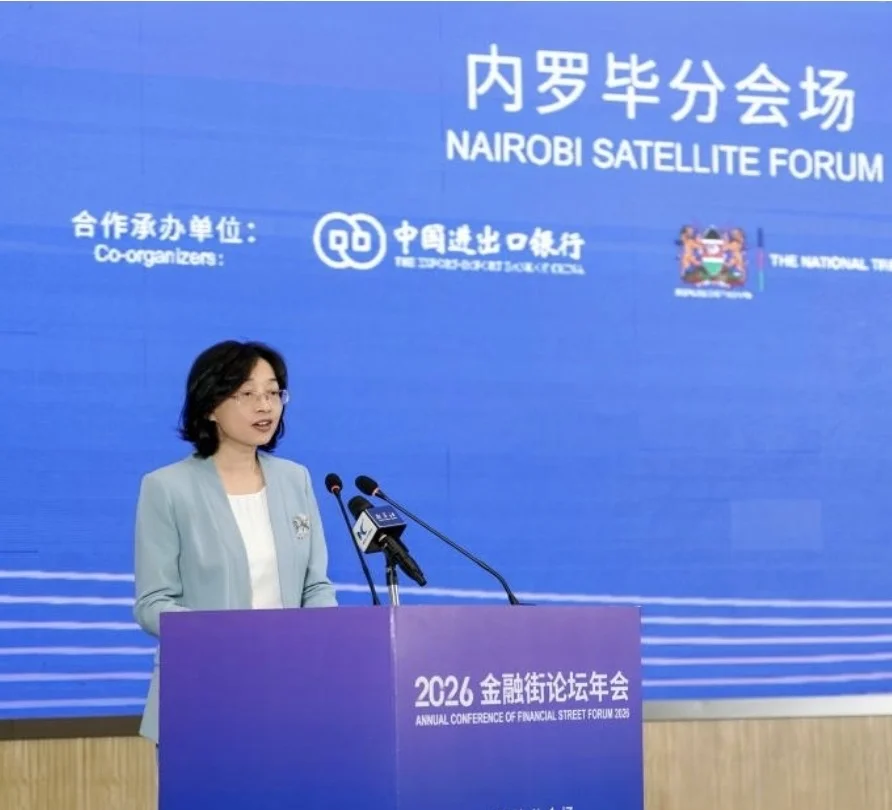
The meeting, organised by the Export-Import Bank of China on October 21, brought together Chinese Ambassador to Kenya Guo Haiyan, National Treasury Cabinet Secretary John Mbadi and Roads and Transport Cabinet Secretary Davis Chirchir.
According to a statement by the Chinese Embassy in Nairobi, the event was a satellite forum of the 2026 Annual Conference of the Financial Street Forum, held simultaneously in Beijing and Nairobi. It was the first time the annual conference had established a satellite forum in Africa.
The discussions focused on deepening financial cooperation, infrastructure development, trade and investment under China’s Belt and Road Initiative (BRI).
The meeting comes as Kenya seeks additional investment to support economic growth while managing public debt and widening opportunities for Kenyan businesses to access international markets.
However, the embassy’s statement did not announce any new financing agreements, project commitments or specific investments arising from the Nairobi meeting.
Trade access and opportunities for Kenyan exporters
One of the issues raised by Ambassador Guo was the need to maximise the benefits of China’s zero-tariff policy for African countries.
The policy could offer Kenyan producers opportunities to sell more goods in the Chinese market by reducing or removing import duties on eligible products. Potential beneficiaries include agricultural producers, manufacturers and businesses involved in processing and exporting goods.
In March 2026, China and Kenya signed an early-harvest arrangement under the Agreement on Economic Partnership for Shared Development.
China's Ministry of Commerce said the arrangement provides zero-tariff treatment for Kenyan goods across 100 per cent of Chinese tariff lines, while Kenya would further open its market to Chinese products.
The potential gains, however, will depend on whether Kenyan businesses can meet Chinese market requirements, produce goods consistently and compete on quality, price and delivery.
For farmers, improved market access could create opportunities to sell more produce abroad. For exporters, it could open a larger market and encourage investment in processing, packaging, storage and logistics.
Those benefits are not automatic. Producers need information about market demand, export certification, food safety requirements and the costs of transporting goods to China.
The government and export-promotion agencies will also need to help smaller businesses understand the requirements and connect them with buyers.
Increased imports from China could also intensify competition for local manufacturers. The overall effect will depend on whether Kenya can expand its exports and attract productive investment alongside the growth in imports.
What financial cooperation could mean for Kenya
Guo also called for deeper China-Africa financial cooperation and the exploration of additional uses for China's Cross-Border Interbank Payment System, commonly known as CIPS.
CIPS is a payment and settlement system that supports cross-border transactions involving the Chinese currency, the renminbi, also known as the yuan.
Greater use of the system could create additional options for Kenyan businesses and financial institutions handling payments involving Chinese suppliers and customers.
For a Kenyan importer buying machinery or industrial equipment from China, efficient payment arrangements could help simplify transactions. Kenyan exporters selling goods to Chinese buyers could also benefit from improved settlement options.
Businesses would still need to assess transaction charges, exchange-rate risks, access to participating banks and applicable financial regulations. The availability of another payment channel would not, by itself, guarantee cheaper transactions.
The embassy statement did not specify how CIPS would be introduced or expanded in Kenya, which institutions would participate or when any new arrangements might take effect.
Infrastructure financing and the debt question
Infrastructure was another major area highlighted at the meeting.
China has played a significant role in Kenya's infrastructure development, including the construction of the Standard Gauge Railway linking Mombasa and Nairobi. Chinese companies have also participated in road construction and other major projects.
Reuters reported in November 2025 that Kenya had turned to Chinese companies for a $1.5 billion highway expansion project, using a combination of debt and equity financing.
The arrangement reflected efforts to pursue infrastructure development through financing structures that do not rely entirely on conventional government borrowing.
Further cooperation could help Kenya mobilise capital for transport networks and other projects that support trade, connect production areas to markets and reduce the cost of moving goods.
Better roads can help farmers transport produce, traders reach customers and businesses distribute products more efficiently. Improved transport infrastructure can also support regional trade by connecting the Port of Mombasa to markets in neighbouring countries.
But the financing terms matter as much as the projects themselves.
Public-private partnerships can spread financing responsibilities between governments and investors, but they also require careful scrutiny of contractual terms, user charges and the allocation of financial risks.
The Nairobi forum did not announce new infrastructure loans or confirm that any specific project would receive additional funding.
What ordinary Kenyans stand to gain
For ordinary Kenyans, the significance of deeper financial and trade cooperation will ultimately depend on whether it creates jobs, supports local businesses and improves access to goods and services.
If expanded trade encourages investment in agricultural processing, manufacturing and logistics, it could create employment beyond the major cities. Farmers and small businesses could also benefit if new market opportunities translate into reliable orders and better returns.
Infrastructure investment could improve connectivity and reduce transport costs, although the benefits would depend on the location, quality and economic usefulness of the projects.
More efficient cross-border payments could help businesses manage transactions with Chinese partners, but consumers would benefit only if any savings were passed on through lower prices or improved services.
There are also risks. Poorly structured borrowing can place additional pressure on public finances, while imports that outcompete locally produced goods could affect some Kenyan businesses.
The challenge for policymakers is therefore to ensure that economic agreements translate into measurable benefits for local enterprises and workers, rather than simply increasing the volume of trade or the number of projects announced.
A partnership whose results will be measured at home
In their remarks, Mbadi and Chirchir described the Belt and Road Initiative as an important platform for mutually beneficial cooperation, trade, investment and diversified financing. They expressed readiness to work with partners to deepen cooperation and explore new development opportunities.
The forum provides another platform for Kenya and China to discuss their economic relationship, but its practical significance will depend on what follows.
For Kenyan businesses, the immediate questions concern access to the Chinese market, the cost of cross-border transactions and opportunities to attract investment. For the government, the challenge is to secure financing on sustainable terms while ensuring that infrastructure and trade policies support domestic economic priorities.
The next measure of progress will not be the number of meetings held in Nairobi and Beijing, but whether the cooperation produces new export opportunities, viable investments and economic benefits that Kenyan businesses and households can actually feel.