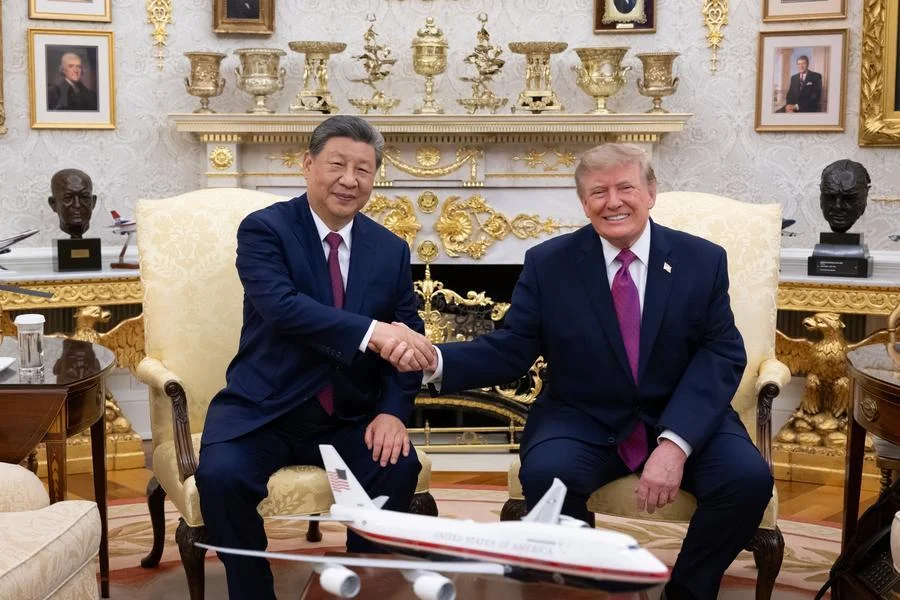
The meeting between Chinese President Xi Jinping and US President Donald Trump in Washington has produced a series of agreements aimed at managing competition between the world's two largest economies.
For Kenya, the significance goes beyond the relationship between Beijing and Washington.
China and the United States are major players in global trade, technology, finance and supply chains. Decisions taken between the two countries can therefore affect economies far beyond their borders, including Kenya.
The two leaders met at the White House on September 24 during Xi's state visit to the United States. The visit was closely watched because of years of trade and technology tensions between Washington and Beijing.
The talks produced agreements covering trade, investment, artificial intelligence, counternarcotics and security.
At the political level, the two sides agreed to work towards what they described as a "constructive China-US relationship of strategic stability based on respect, fairness and reciprocity".
China's Foreign Ministry said Xi and Trump agreed that cooperation should be strengthened while competition and differences are managed. The two presidents also agreed to support each other as China hosts the APEC Economic Leaders' Meeting and the US hosts the G20 Summit later this year.
The agreements do not end the strategic competition between Beijing and Washington. Instead, they create channels through which the two countries can manage some of their disagreements.
That distinction matters for countries such as Kenya.
Why trade matters to Kenya
Trade was at the centre of the discussions.
The United States and China have spent years imposing tariffs and other trade restrictions on each other's goods. The dispute has created uncertainty for businesses and contributed to concerns about global supply chains.
The latest understanding seeks to move some of that competition towards structured negotiations.
The White House said the two countries agreed on more favourable tariff treatment for $30 billion of non-sensitive goods in each direction. They also agreed to establish a working group on agricultural market access. The two countries have operationalised boards dealing with trade and investment to provide formal channels for addressing economic disagreements.
The two sides are also continuing discussions on critical minerals and supply chains.
This is relevant to Kenya because the country is deeply connected to international trade.
Kenya's imports from China, India, Saudi Arabia and the United Arab Emirates accounted for 55.1 per cent of its total import bill in the first half of 2026, according to data reported by Business Daily from the Kenya National Bureau of Statistics. China alone recorded a 37.2 per cent increase in exports to Kenya during the period.
A disruption in major global supply chains can therefore eventually be felt by Kenyan businesses and consumers through the availability and cost of goods.
The issue is particularly important for Kenyan businesses importing machinery, electronics, industrial supplies and consumer products from Asia.
China-Kenya trade is also changing
The Xi-Trump meeting comes at a time when Kenya is deepening its own economic relationship with China.
In March 2026, Kenya and China signed an Early Harvest Arrangement under the Agreement on Economic Partnership for Shared Development.
According to China's Ministry of Commerce, the arrangement provides for zero-tariff treatment on 100 per cent of tariff lines for Kenyan products entering China, while Kenya will further open its market to Chinese products.
The arrangement is potentially important for Kenyan exporters because access to the Chinese market is one of the areas where the country has sought to expand opportunities.
Kenya's relationship with China is not limited to the movement of finished goods.
A joint statement issued by Kenya and China in 2025 said the two countries wanted to encourage Chinese investment in Kenya, expand Kenyan exports to China and develop industrial capacity and value chains.
The two countries also identified infrastructure, manufacturing, healthcare, finance and other areas for cooperation.
This provides an important lens through which Kenyans can understand the latest US-China developments.
The question is not simply whether Washington and Beijing have reached an agreement.
It is also how changes in the world's two largest economies affect Kenya's ability to trade, attract investment, develop industries and participate in global supply chains.
Artificial intelligence was another important element of the discussions.
China and the US are competing heavily in advanced technology and AI. At the same time, both countries recognise the need to address the risks associated with rapidly developing AI systems.
The two sides agreed to establish a dialogue on what the US describes as "super intelligence". The mechanism will allow the countries to discuss the risks and benefits of emerging AI technologies.
They also agreed to establish a communication channel for AI-related incidents. The next exchange is expected by November 2026.
Xi said China and the US have strong AI capabilities and should use dialogue to address risks, including the misuse and abuse of AI.
He also said AI development should remain under human control and serve people's interests.
For Kenya, the AI discussion has practical relevance.
AI is increasingly being used in Kenyan newsrooms, businesses, education, financial services, healthcare and government services.
Developments in China and the US influence the technologies, platforms and systems that eventually become available to Kenyan users.
The US-China discussion also raises a broader question for countries such as Kenya: how can developing economies use AI to increase productivity while managing risks involving misinformation, privacy, employment and accountability?
For Kenya-China relations, this is an area worth watching closely because China is already an important technology partner for Kenya.
Critical minerals add another dimension
The meeting also took place against growing international competition over critical minerals.
Rare earth elements and other critical minerals are important in the production of technologies ranging from electronics to advanced industrial and defence equipment.
Kenya has itself become part of this wider conversation.
In September, the United States said it would support Kenya's development of a critical-minerals processing industry. The announcement came as Washington seeks to diversify supply chains and reduce dependence on China for some minerals.
The focus includes the Mrima Hill deposit on Kenya's coast, which is believed to contain rare earth minerals and niobium.
This places Kenya in an increasingly important position in the global competition for strategic resources.
For Kenya, the key issue is not simply which major power has access to its minerals.
It is whether the country can attract investment that creates local processing, jobs, technology transfer and other forms of value addition.
Security and global stability
The discussions also covered international security.
Xi and Trump discussed the Middle East, the Ukraine crisis and the Korean Peninsula. They also agreed on the importance of military communication and mechanisms for preventing conflicts, according to the Chinese readout.
The White House said the two countries also discussed Iran's nuclear programme and international waterways.
The two sides further agreed to strengthen cooperation on counternarcotics.
China said its law-enforcement agencies had recently cooperated with US authorities on cases involving new psychoactive substances and precursor chemicals.
These issues may appear distant from Kenya, but global security developments can affect international trade, transport, energy prices and investment.
For a trading country connected to Asia, Europe, the Middle East and the wider global economy, international stability matters.
The relationship will also be tested through multilateral institutions.
China will host the APEC Economic Leaders' Meeting in November 2026. The United States will host the G20 Leaders' Summit in December.
Xi and Trump agreed to support each other's hosting of the two meetings. Both leaders have indicated an intention to attend the other's summit.
These meetings will provide additional platforms for discussions on trade, investment, technology and the global economy.
Although Kenya is not an APEC member, developments in APEC economies can affect Kenya because many of the world's major trading and manufacturing economies participate in the grouping.
Kenya is also not a G20 member, but G20 decisions and discussions can influence the global economic environment in which Kenya operates.
Competition has not disappeared
The latest agreements should not be interpreted as the end of China-US rivalry.
The two countries continue to compete over technology, trade, strategic influence and critical supply chains.
The Council on Foreign Relations noted in its 2026 assessment of the relationship that tariffs, rare-earth restrictions and technology controls remain major points of tension, even as the two countries seek to prevent a complete economic separation.
That makes the latest meeting important for another reason.
It demonstrates an attempt by the two largest economies to create mechanisms for managing disagreements without allowing every dispute to become a wider confrontation.
Xi has described the desired relationship as one in which cooperation is strengthened, competition remains within limits and differences are managed.
Trump, meanwhile, described the talks as constructive and said the two sides had achieved positive outcomes.
The durability of the agreements will depend on how they are implemented.
What should Kenya watch?
For Kenyans, the most useful way to follow the Xi-Trump understanding is to look beyond the diplomatic headlines.
Four areas deserve particular attention.
First, trade. Changes in US-China tariffs can influence global prices, shipping patterns and supply chains, with consequences for Kenyan importers and consumers.
Second, technology. The US-China competition in AI and other advanced technologies will influence the global technology landscape in which Kenyan businesses, universities and innovators operate.
Third, investment. Competition for critical minerals and manufacturing capacity could create opportunities for Kenya if the country succeeds in attracting investment while securing local value addition.
Fourth, China-Kenya trade. The Early Harvest Arrangement between Kenya and China gives Kenyan exporters a new framework for accessing the Chinese market. Its practical impact will depend on whether Kenyan producers can increase the volume, quality and consistency of products supplied to China.
The Xi-Trump meeting is therefore not simply a story about two presidents meeting in Washington.
It is part of a much bigger story about how the world's major economic powers are managing competition, technology, trade and global supply chains.
For Kenya, understanding these developments is important because the country's economic choices are increasingly linked to what happens in Beijing, Washington and other major centres of global economic power.